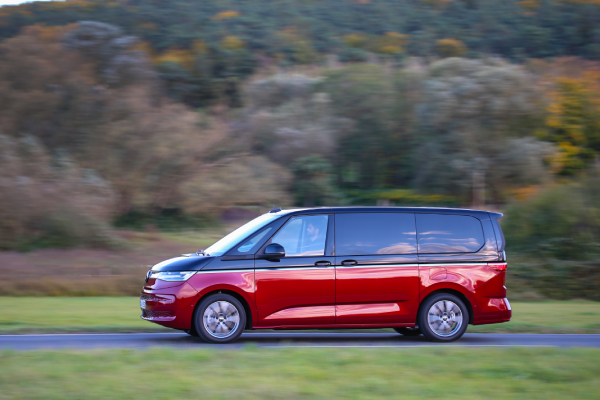
- Advanced Plug-In Hybrid Technology with High-Performance charging capability.
- New comfort feature: stationary air conditioning as standard enables emission-free cooling and heating when charging, parking or camping.
- Up to 95 km electric range: New 19.7 kWh battery and quick-charging function.
- An additional electric rear axle ensures that the Caravelle also feels at home off-road.
Kariega, 6 February 2026 – Building on decades of trusted mobility solutions, Volkswagen Commercial Vehicles will launch the all-new Caravelle plug-in hybrid 4MOTION in the South African market towards mid-year of 2026.
More than seven decades ago, at Volkswagen Group Africa’s production plant in Kariega, a simple, hard-working Volkswagen bus first rolled into local history laying the foundation for a nameplate that would become woven into South Africa’s cultural and economic fabric. From the iconic T1 through successive generations up to the refined and technologically advanced T6.1, the Volkswagen Bus evolved in step with the country itself, serving families, entrepreneurs and adventurers alike with unmistakable character and purpose.
Today, that legacy is reimagined in the sophisticated T7 Caravelle, signalling a bold new chapter defined by comfort, connectivity and modern mobility. Looking ahead, Volkswagen is firmly future-ready for the South African market, embracing electrification through plug-in hybrid models that balance efficiency with everyday usability, a clear statement of intent that the spirit of the original Bus lives on, re-engineered for a cleaner, smarter future.
Electric driving: The Caravelle starts as plug-in hybrid electric vehicle model with electric all-wheel drive, one electric drive motor per axle drives the front and rear axles. Both motors thus ensure optimum drive-off performance and traction. The prerequisite for this is that the battery is sufficiently charged. Thanks to a capacity of 19.7 kWh, fast charging functions and highly effective energy recovery, this is usually the case.
When the battery is fully charged, the economical plug-in hybrid electric vehicle enables purely electric distances of up to 91 kilometres. The Caravelle can be driven at speeds of up to 190 km/h, with hybrid driving up to 130 km/h. The four driving profiles Eco, Comfort, Sport and Individual are optionally available in the hybrid models.
Electric stationary air conditioning: As plug-in hybrid electric vehicle models, the Caravelle offers electric stationary air conditioning as standard, in addition to the air conditioning system for driving operation. It can be used to cool, ventilate and heat the Caravelle when charging, parking or camping.
Stationary air conditioning offers a number of advantages: when charging the lithium-ion battery, the vehicle interior is already brought to the desired temperature before the start of the journey. This increases comfort and the electric range, as the heating or air conditioning function requires less energy to cool or heat the air in the interior when starting a journey.
With an external power supply, the stationary air conditioning is active for up to 30 minutes. If it operates on its own using the power supply of the high-voltage battery, the air conditioning switches off after 10 minutes. The stationary air conditioning is activated on the Infotainment system or using the smartphone app.
Hybrid travel: As outlined, the Caravelle with the new plug-in hybrid electric vehicle always start electrically when the battery has sufficient charge. The hybrid strategy is designed so that the Caravelle eHybrid 4MOTION use the electrical energy from the high-voltage battery first.
Depending on the driving situation and driving profile, they are powered by the front electric drive motor up to 130 km/h and, if necessary, also by the rear electric drive motor. Above 130 km/h, the rear axle is automatically removed from the drive system to make energy consumption as economical as possible.
In the partial-load range, the petrol engine switches off as often as possible; the Caravelle then coasts either without any engine support or uses the electric drive alone. This interaction takes place fully automatically and almost imperceptibly.
As an option, the Caravelle eHybrid 4MOTION has the four driving profiles Eco, Comfort, Sport and Individual. In the Eco profile, the power and torque are reduced in hybrid operation. Comfort mode offers optimum drive comfort, while Sport delivers the maximum system power in hybrid mode.
Driving with all-wheel drive: The power distribution of the eHybrid 4MOTION system is regulated via Electronic Stability Control and is variable depending on the drive situation or traction at the axles. This means up to 100 per cent of the drive force can be directed to the front or rear axle.
Compared with a conventional all-wheel drive system, Volkswagen Commercial Vehicles can control the electric rear axle of the Caravelle. This feature is a major advantage, as it allows for more power and traction as well as more dynamic torque control.
Drive technology in detail: The module consists of the 6-speed dual clutch gearbox and the front-axle electric drive motor. A high-tech turbocharged petrol engine with the designation 1.5 TSI evo2 is used in the Caravelle. The engine delivers an output of 130 kW and a maximum torque of 250 Nm.
As a third technical module, the second electric drive motor is used on the torsion beam rear axle. This electric drive motor delivers 100 kW and contributes a peak torque of 250 Nm. This power is transmitted to the rear axle via a one-speed gearbox.
Another key component of the plug-in hybrid all-wheel drive is the new high-voltage battery. With the stated 19.7 kWh, it offers almost twice as much net energy content as its counterpart in the Caravelle eHybrid with front-wheel drive.
Two power electronics modules are used on board the new Caravelle eHybrid 4MOTION as a further special feature compared with a plug-in hybrid with pure front-wheel or rear-wheel drive. The Caravelle can charge with up to 11 kW at AC charging points and up to 50 kW at DC rapid charging stations. With this DC power, the battery can be charged from 10 to 80 per cent in about 26 minutes.
